Tuesday, September 26, 2017

My Legs and I


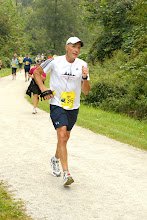
Recently I received a link to a video capturing my crossing of the finish line of the recent Akron Marathon in which I ran/walked/stumbled/ambled for 13.1 miles before the race mercifully came to a close at Akron’s Canal Park stadium. I’ll be honest: my first response to receiving that link was anything but excitement. The last thing that I wanted to do was to relive any aspect of that race.

It was my 20th half marathon and my slowest by a long shot. I knew in advance that my time would be bad – the high temperatures predicted for the race would exact their pound of flesh. I knew it would be bad, I knew it would be challenging, but it was much tougher than I thought it would be. The first half was great fun, but by mile 10, I was done. Unfortunately the finish line was still over three miles away.

I often talk to my legs during the latter stages of a long race. “You can do it,” I will say – usually not too loudly. “You’ve done this before many times.” I have a few other things I say as well, but I would rather keep them private. These words almost always help my legs to keep grinding.

This was my legs’ response to my most recent attempts at encouragement: “Just who are you again? O yeah, I remember - that fool who didn’t ask our advice when signing up for this Akron race. You just watch. I can stop running without your permission. I’ll show you who is in charge.”

And sure enough – despite my fantastic motivational talk – my legs stopped running (or whatever you could say I was doing at that time) and began to walk. I realized that I didn’t have a whole lot of say in the matter. I could not will them to go any faster. Haven’t we all had parts of our body independently make choices for the whole group? It is often a knee or a back or it could be a stomach or a bladder. We can be made to feel like we are just along for the ride rather than being the operator of the attraction.

Over those last three miles my legs and I gradually reached an understanding – my legs needed to learn that under no circumstances was I going to quit and that they were coming along with me whether they liked it or not, whether they allowed me to run or to walk or if I had to drag them along like they were attempting a form of civil disobedience.. And I needed to learn from my legs that they were willing to assist me in my ludicrous pursuit of yet one more shiny finisher’s medal as long as I allowed them to dictate the pace and if I used my GPS watch only for personal amusement rather than direction.

Thankfully for both of us, we came to realize that not only was walking just as painful as running, but that it extended the time that we had to put up with each other. So I was able to run more than I walked in those final miles.

Which brings us to that video of the finish line. You won’t see my lips moving – my legs and I had given up talking at that point. But there I am stumbling in with a gait that looks like a old man’s poorly orchestrated attempt to run his 20th half marathon. As I reach that final and definitive “this is the end” black line, my legs stop running one millimeter after I cross it. They had had enough of my baloney, and I had had enough of their rebellion. I got that medal – “Look I am a finisher.” My legs didn’t even look up. I sensed their disgust or was it pity? We had to maneuver a long walk up a hill to get back to the car. I will not repeat what my legs were saying during that time.

When looking at the race results later that day, I was stunned to learn that while 2271 runners finished ahead of me (that was no surprise) 730 people finished behind me. It didn’t make me feel any better, but in most cases I would advise those people to consider a different form of fitness. I was even ahead of about 1/3 of the males in my age group. It might be time for them to turn their attention to Yahtzee before it is too late.

The truth is I respect every runner who finished the course that day – regardless of age or pace. More than one runner failed to reach to Canal Park and others needed medical treatment. Just getting to the finish line was a victory. I salute all who made it.

In the hours following that race, I wondered if I needed to redirect my time to something of more lasting value such as Facebook or my Fantasy Football team. Who needed the pain and humiliation of running anyway? My legs and I didn’t talk for a few days. What could we say?

But yesterday morning – two days after that racing disaster, I turned to my legs and asked: “Hey, you want to run?” “O boy, do I?” they replied. And yes, they were sore and yes, we moved slowly together. But we both loved it. It was like that old man sitting on the stump at the end of the book “The Giving Tree.”  We were both happy.

A few hours later I signed up for half marathon #21. My legs and I have a lot of work to do.


Tuesday, April 25, 2017

Send Lawyers, Guns, and Money


“Send lawyers, guns, and money” is a repeating lyric in a late 1970’s song “Lawyers, Guns, and Money” by Warren Zevon. Unfortunately it also seems to describe the current needs of our Regional Church – the Christian Church in Ohio. Not the guns part hopefully, but certainly legal advice, and definitely money.
I know that some of you have received one or another email from the Chair of our Regional Church Council lifting up part of the story. He is among those tasked with steering our Regional Church through some turbulent times, and it won’t be easy.
Few of the details have been shared – whether on the advice of lawyers or out of a sense of propriety - but as best I have been able to discern from my “out of the loop” position as a local church pastor in Akron, Ohio - the past decade or so at our Regional office has been allegedly stained by that age old and yet always popular mixture of the misuse of power and of money with a few other ingredients thrown in that I hesitate to mention.  I don’t share this news lightly but sadly.
I’ll be honest – I have a whole lot of feelings about this situation – sadness, anger, outrage, disbelief, confusion, disappointment, and maybe even a bit of fear. Though not a member of any Regional Council or Committee, I wonder if I could have done anything to prevent it. I am still working through my emotions and my possible culpability. And I know that a lot of other people are sorting through this wreckage as well.
When such a thing happens – and supposedly occurs not once but for years – it speaks to more than one person behaving badly. It indicates that an entire system has failed to prevent such abuse. It also suggests to me that the cleanup from this situation involves a much more extensive remedy than a single staff member moving on.
I am reminded of the flooding that occurred in the town where I live in the summer of 2003. As a result of historic amounts of rainfall, torrents of nasty water containing some very bad things flooded many residents’ basements not once but twice. I remember people’s ruined carpets and other possessions piled high on the devil strip, and I also recall scrubbing our basement with bleach to try to remove the germs and the odor. But we had it easy – two local men, one a teenager, were killed by rising floodwaters. None of us felt truly safe until the city redesigned the sewage and storm drain systems to reroute the water if it ever came at that intensity. Yet even now when heavy rains come, we check the basement just in case.
I have the feeling that a thorough scrubbing is needed for our Regional Church – maybe more than once. And a redesign of our structure is needed as well so that such a thing doesn’t happen again. Yet even after a new system, I think we’ll need to check in from time to time just in case.
What does all this mean to us at the New Horizons Christian Church?
For one thing, it should serve as a reminder for us to be as open and transparent as we can possibly be especially in matters related to finances as well as other significant decision-making opportunities. Some of my colleagues in ministry have been surprised to learn that we publicly post our local church operating budget including salaries. I think that people have a right to know how their offerings are spent.
As far as our relationship with the Regional Church is concerned, our denominational structure is not a top-down system in which our Regional or General church leaders give us orders. Disciples of Christ have always been fiercely independent and even a bit suspicious of authority. We participate freely with other churches because we know that together we can create ministries that we cannot do by ourselves. Our Regional ministries to young people and children – especially our ministries at Camp Christian - are the most visible manifestation of our cooperation with other churches in Ohio. It is not yet clear how the troubles at our Regional office will impact our shared ministries, but we have been assured that Camp Christian will be open and running once again this summer.
Ministries of the Christian Church in Ohio have transformed my life. My experiences at Camp Christian helped lead to my call to ministry as well as connected me to Holly. We will celebrate 36 years of marriage in a few months. And our children have also been touched by Camp Christian as have many, many of the young people at the New Horizons Christian Church. For the third year in a row, we’ll be sending a large group to Camp this summer. It would be difficult to overestimate the positive impact that Camp Christian and other Regional programs have had on so many people especially young people.
            I would ask that you keep our Regional Church in your prayers in the coming months. We are all part of the Body of Christ. As Paul wrote centuries ago in 1 Corinthians 12:26, “If one part suffers, every part suffers with it; if one part is honored, every part rejoice with it.” There is no quick fix for what has happened, and it will take time for the restoration of healthy behavior and healthy relationships. It may get worse before it gets better. But I am hoping for some better days ahead – some days of rejoicing ahead - even if it takes some time for those days to come.

Jim


Wednesday, October 26, 2016

Anything is possible

All things are possible with God.” Jesus

“In Northeast Ohio, nothing is given. Everything is earned. You work for what you have.” Lebron


            This has been an incredible year for me. On June 9, I turned 60 years old. In celebration of my birth, the CAVS won their first NBA championship ten days later. They were down three games to one but found a way to win it all anyway. Less than three weeks after that, our grandson Joseph was born. And the Indians have done their part by winning their way into their first World Series since 1997. You would have to say that I am on a roll.
            When I was a younger man, I didn’t believe that I would reach 60. I don’t think I was fatalistic but 60 seemed impossibly old – an age for other people but not for me. And I also didn’t think I would be a grandfather either. As I grew older and those things became more likely, the chance that any Cleveland sports team might win a championship in my lifetime seemed to become more remote. I witnessed in person “The Drive” Game in January of 1987 when the Browns lost to the Bronco’s and have caught my share of CAVS playoff games over the years. I have seen Lebron James arrive in Cleveland, leave Cleveland, and return once again. Until June of 2016, I saw Cleveland teams get close now and again but always come up short.
            I accepted getting close occasionally yet losing as part of the fabric of Northeast Ohio culture, and I was ok with it.  So I was as stunned as anyone on the planet when the final seconds of the NBA championship game ran out and the CAVS actually won. Like many Cleveland fans, I looked at the screen expecting a late call, a disqualification, or Lucy pulling the football away from a charging Charlie Brown. It just didn’t seem possible. The seeming impossible actually happened.
            I have been around long enough to know that there are many more important things than professional sports teams. Each week our prayer team lifts up people and situations that couldn’t be more serious. A winning or losing sports team can seem pretty trivial. And I have noticed that many of my daily concerns haven’t changed a whole lot since the CAVS won, and my life is unlikely to be transformed by an Indians World Series win either.
But the success of these teams has made daily life in this part of the world just a little bit sweeter. Just a bit.
            When Lebron James was returning to Cleveland a few years ago, he was quoted in Sports Illustrated as saying: “In Northeast Ohio, nothing is given. Everything is earned. You work for what you have.” It was his way of saying that winning a championship was not guaranteed and was bound to be difficult to achieve. And he was right.
            The CAVS worked hard to win that championship, but I didn’t do a thing except show up at a playoff game against Toronto and yell until I was hoarse. We were so far away from the court that I don’t think Lebron heard us.
            So it is accurate to say that for me – and for just about every Northeast Ohio resident – the championship could only be described as a gift – a gift to us earned by the effort and determination of others. I didn’t work for it. I didn’t earn it. Yet it was given to me just the same. 
There is certainly a value to setting a goal and working towards it. We can achieve many good things in life if we work hard enough. Yet some of the best things in life cannot be earned no matter how much we try. We can only receive them as a gift.
We are offered the gift of salvation and the forgiveness of our sins, and there is absolutely nothing we can do to earn it. No good works will suffice. Instead it is the work of Jesus, his willingness to die for us on the cross, that earns our freedom for us. We didn’t do anything to deserve it.
Even at the advanced age of 60, I still have some things I am working for, but I am so grateful for the blessings and gifts that have come into my life because of the hard work and efforts of others. Family (including grandchildren), love, and friends are among the best gifts that I have even received. I don’t deserve them, but I cherish and savor them just the same.
The Cubs haven’t won a World Series title in 108 years, and the Indians last won in 1948. Unless the World Series ends in a tie, one team’s fans will soon be euphoric and the others disappointed. I hope that the gift of a World Championship comes to Cleveland once again, but I can’t say that we deserve it more than Cubs fans do. And I tend to think that God won’t intervene in the outcome no matter how many prayers are lifted up by faithful fans.
But, as I said before, I am on a roll. I have seen things this year I never thought I would experience. And the year – and the baseball season – isn’t over just yet.  I am beginning to believe that just about anything is possible.


Monday, May 2, 2016

Adventures in Aging

A few days ago, I was running in the final mile of the Capital City Half Marathon in Columbus, Ohio. This will be my last half marathon before I turn 60. At this point in the race I know a few things: 1) I will finish; 2) My time will be about my worst half marathon time ever; 3) Despite #2, I am having a good time; and 4) I have only one goal left – get across that finish line without incident or embarrassment. In previous Cap City races, I have seen people collapse during that last mile as well as at the finish line. I don’t want to join them.
I am glad that there are no mirrors or store windows nearby. I have no need to see what I look like at this point of the race. This is not a matter of vanity. It is a matter of reality. I have little self-respect left. All I want to see is that finish line.
But, unfortunately for me, a young man in his 20’s or 30’s provides me with the feedback that I am not seeking or wanting. He runs alongside me, and after sizing me up, he figures that I need a bit of encouragement. He says: “You are going to make it,” then he adds that terrible word at the end of his sentence: “SIR.”
“You are going to make it, SIR.” I can only imagine that he says this because he doesn’t want me to collapse in his general area and present him with the ethical challenge of whether or not to stop or to keep running to get his PR. If he is running near me, he’s not very fast. His words don’t seem uplifting to me. Instead of encouragement, what I hear is: “Man, you look awful. Should someone of your advanced years be running this kind of race? Maybe you should be watching, not running, SIR.”
If I had had enough energy, I would have kicked him. But I probably would have tripped. Instead I said: “We are BOTH going to make it.” At the end of my sentence, I wanted to add (like Dirty Harry would have) “Punk” or at least “Callow Race Participant,” but I had used up the six words I had left.
I don’t remember if he finished ahead of me or behind me. If he finished behind me, I hope he has a self-image healthy enough to withstand the shame of finishing behind a man old enough to be his father. A man who he needed to call: “Sir.”
A recent “New York Times” article asserted that when runners get older, they also get slower. That isn’t exactly shocking news. Ray Fair, a professor at Yale, has created a chart to predict how much slower a runner will get every year after they have passed their peak years. This is not a chart I am all that interested in studying. Who needs a chart about aging when you have yourself as a reference? I’ve got years of race times that tell me all I need to know.
Getting older has its benefits, but your body’s betrayal is not one of them. Just a few days before the race, I was paying a specialist affiliated with a local hospital to do things with my body that I would have punched him for attempting to do to me when I was a teenager.
Trust me. When they say, “Just relax,” that’s the last thing you are able to do. When they say: “You’ll feel a little pressure,” what they really mean is “This is going to be a special pain that you won’t forget for a long time.” And this is just the diagnostic process. I am sure that the treatment will be even more fun.
So a young man calling me “Sir” as I shuffled my way through the last mile of a half- marathon wasn’t really all that bad compared to my intimate time with my new special doctor friend. What I am unclear about is whether or not I am supposed to send the doctor flowers. Maybe after my next visit.
So, runners, walkers, shufflers of all ages and shapes and sizes, here are my words for you: “You are going to make it.” Really. If you are moving ahead at all, I complement you. Keep it up. I am proud of you. It will help you stay as young as you can as long as you can.  Moving has got to be less painful than stopping at the doctor’s office.


Wednesday, August 26, 2015


Among the many great benefits of being a grandparent is getting to experience old things in a new way. Abigail turned a year old in July and almost every day she encounters something new to her or is excited about something that most of us have long ago stopped noticing. I have the privilege of spending time with her every Monday, and as luck would have it, Monday is garbage pick-up day in Dublin, Ohio. Not exactly a banner day for most of us – not something that we get excited about – but Abigail is fascinated with the big yellow garbage truck that rolls down her street. It is large and loud, and Abigail loves it. A few weeks ago, I was taking her for a walk and numerous garbage trucks crossed our path. We had hit the mother lode. One driver even stopped to wave to Abigail. I can’t remember the last time that seeing a garbage truck was so much fun for me. She is also fascinated by the airplanes and helicopters that fly overhead. She cranes her head skyward to follow their paths as they go by.
On other occasions Abigail will be in the yard pulling up a blade of grass or studying some bug or other object that the rest of us overlook. It is all so captivating to her. She has some really cool toys, but she is just as likely to be interested in a dried up leaf that she finds on the ground.
Jesus tells us to consider the lilies and study the ravens, but most of us don’t do that. Abigail does. She is constantly learning something new and finds joy in the simplest things that comes her way. Jesus also advises us that unless we become like little children we will never enter the kingdom of God. Jesus associates childhood with humility and openness to hearing and experiencing new things such as this thing that Jesus calls the Kingdom of God.
Abigail is growing up, but I hope that she never grows so old that she ceases to be curious and open to all the ways that God shares His beautiful creation with us. As for the rest of us, let us be reminded that even a garbage truck or a dried up leaf might contain a lesson for us.


Tuesday, June 23, 2015

The Confirmation Class of 1981


            A few days ago I was informed that I was tagged in a Facebook posting. The same kind of thing happens to millions of people every day who are registered on Facebook. Sometimes the postings are mundane or profane, but this one was deeper than that.
            A few members of the first youth group I ever worked with scanned in a picture of their confirmation class from the spring of 1981 as well as a copy of the worship bulletin the morning the class joined the Church of the Master. I had only been at the church a few weeks and wasn’t in the picture, but my name was listed in the staff section. According to the bulletin, 357 people had attended worship the week before, and the offering had been $2,093.65 (not a large offering these days but it bought a lot more back then – my salary was $13,000.)
            The real treasure wasn’t found in the bulletin but in the picture of thirteen 12 and 13 year olds who had just confessed their faith and become members of the church. As one of the guys (now in his mid-forties) wrote: “We mostly look like the middle school dorks that we were (but not the girls).” I was just shy of 25 years old when the picture was taken, and I didn’t feel that much older than the youth group members. That’s probably why the group was so fun and so successful.
            John Deever, one of the group, described me as a “very tolerant, kind, generous, and trustable” youth pastor, but those adjectives more accurately describe the church that offered me my first position in ministry and allowed me to figure it all out. Many clergy denigrate youth ministry and many clergy also drop out of ministry after their first church leadership experience,  but I received a renewed call to ministry while sharing a significant amount of experiences with the young men and women in that picture. What great people you were. We grew up together. Well, most of us anyway.
            A few years after the picture was taken, many of us were together on a Habitat for Humanity mission trip in Baldwin, Michigan when we received word that one of the girls (who often went on these trips with us) was killed by a falling tree branch while peddling her bike home in a storm not far from the church. We were devastated and spent time trying to decide whether or not to just come home. The news had an extra element of grief because that young woman had already been through many struggles and finally things seemed to be headed her way. That evening one of the group pointed to a star in the sky and expressed his conviction that that star was our friend who had died.
            To say much else would sound trite or maudlin, and I don’t want to be either. I am sure that members of the Church of the Master Confirmation Class of 1981 have had their share of joys as well as tragedies. Thirty-four years have a way of delivering their share of both. I salute those of you who have continued to support each other these many years, and I thank you for all you did for me.


Friday, May 29, 2015

Those Zero Anniversaries


            We’ve all had them, haven’t we? They are not something that we usually earn, but if we live long enough more than a few of them will arrive at our doorstep. Sometimes we anticipate and plan for them and even celebrate them – sometimes in a big way with a big party. Other times, they show up and we would just as soon forget them.

In either instance, we open our door one day and there they are like freshly delivered Amazon packages waiting to be opened. In some cases, we are excited and filled with expectation – “Hurrah, it is finally here.” In other cases, we think: “O, you again. I think I’ll leave you in the box.”

I am talking about those “zero” anniversaries – the 10th, 20th, 30th, 40th, 50th (or more) year after an important milestone in our lives. These events include a number of life passages such as graduation from high school or college, your wedding day, your birthday, your sobriety, the birth of a child or grandchild or great-grandchild, the death of a loved one, your being declared “cancer-free,” and so on.

One year when I served on our Ohio Regional staff, a number of us all had zero birthdays in the same year: Our bookkeeper turned 30, I became 40, one secretary turned 50, and another person was 60. Some folks get depressed about these zero birthdays, so I decided to take all the zeros out to lunch. We had fun, and I remember the non-zeros feeling a bit left out. We may have graciously shared our birthday cake with them. Maybe.

I’ve got a few zeros this year: 30 years ago on Mother’s Day I was ordained into ministry at my home church in Warren, Ohio (I shared this in a sermon a few weeks back); 40 years ago this week my father died just a week shy of his 48th birthday; in September our oldest son Jacob will transition from his 20’s to being a 30 year old.

Each of these events was among the defining events of my life which still shape and inform me. One of the lessons that my father’s early death continues to teach me is that “about that day or hour no one knows.” None of us is guaranteed even one more day or life either for ourselves or for those we love. This has not made me fatalistic or despairing, but has helped me appreciate the value of each and every day that we do have with those we love. The taking of vows at my ordination (not unlike the taking of wedding vows) helped me to understand that despite not knowing how many days that we might have (or what those days might hold) that we can still commit ourselves to something of value and purpose long term. The birth of a child to Holly and I not only launched a new phase of our lives together but gave us the chance to sacrifice and to serve in a way that we could not have done otherwise. It also brought a sense of hope and joy and anticipation about the future.

What are the important milestones of your life? How did they change you? As you think about them on those zero anniversaries, do they still teach you something of importance?


Wednesday, April 1, 2015

In praise of single-tasking

I am not all that perceptive, and it can take a while for something to make an impact on me. But eventually even the obvious can catch my attention. I have been babysitting our granddaughter Abigail once a week since the middle of October, and here’s something I have learned: Babysitting a granddaughter is easier than parenting two sons – at least so far. When I was with Jacob and Joshua when they were growing up, I rarely was able to devote my full time and attention just to them. There was always something else to take care of such as church work or laundry or household concerns of one kind or another. I was feeding Abigail a few weeks ago, and it was taking a bit longer than I had anticipated. But I wasn’t the slightest bit impatient since I had nothing else to do or nowhere else to go. I didn’t have to rush her through her meal so I could pack her up and run some errands. The only item listed on my agenda that day was: “Watch Abigail.” I am often an impatient person, and it is usually because my mind is already moving beyond what I am doing to what I need to be doing. It is rare to have only one item on my agenda for an entire day, but on Mondays that’s the way it almost always is. I bring along my laptop, and when Abigail takes a nap I sometimes do some writing, sermon research, or return some emails (if I am not taking a nap at the same time that she sleeps). But I never assume I will have the time to do any of those things so I am not uptight if I don’t get them done. On one day of the week, all of my time, attention, and devotion are directed to one person. I am not in any hurry to move from one activity to another. I am not saying that it isn’t tiring because I can be exhausted by the end of the day after my drive home. And the more mobile she gets the more interesting things will become. It can be tiring but it is as simple and uncomplicated as a day could be. My priorities are clear and not in conflict when I am “single-tasking.” How many of us are ever able to give a full day of undivided attention to just one person without looking at the clock and thinking about what comes next? How many of us are able to direct a day’s worth of time, attention, and devotion to God alone? For most of us most of the time, the answer to each question is “never.” Most of us have a hard enough time focusing on God for one hour during Sunday worship without our attention wandering to other things that we will be doing that day. Most of us have busy lives with crowded schedules that do not easily lend themselves to prioritizing a single person for an entire day. Numerous studies have suggested that multi-tasking (which most of us do on a regular basis) just doesn’t work very well. Our performance is less than ideal when we are not focused. One report suggests that we damage our brains and our IQ decreases when we attempt too many intense multi-tasking activities at the same time. I am under the impression that Jesus didn’t do a lot of multi-tasking. He seemed to be focused on the moment – on one thing at a time and one person at a time – regardless of how much demand there was for his time and attention. And there was always someone or something needing his time and his consideration. Jesus may not have always given people everything they wanted – some went away unhappy or upset – but he always gave them his full attention. And many people probably had never been looked at that deeply or completely in their entire lives. You can argue that Jesus helped transform the world as much through his ability to honor and to elevate individual people as he did through any particular teaching or commandment. Jesus regarded every person from the prostitute to the priest as deserving the best of what he had to offer. If you want to transform your own world, try simplifying and eliminating rather than complicating and adding. Do fewer things but make sure they are the most important things. If you can’t give things up easily (or if your boss keeps adding), then at least do one thing at a time. And try the same approach to your relationships. Pick the ones that are the most important to you and give them more of your undivided time and focused attention. Go deeper with them rather than cultivating too many surface level relationships that will bear little fruit. Certain people are worth more of your life, aren’t they? Make a decision to spend concentrated time with God. It is a new season – a season of new life. Make your own life more life-giving (for you and for others) by eliminating multitasking and replacing it with “single tasking.” And try taking those naps when possible. You won’t regret it.

Tuesday, February 24, 2015

What's Trending Now?

Let me tell you something that never fails to bug me. I’ll be watching the local news (yes, I still watch TV news, and I read a hard copy of a newspaper almost every day – in other words I am old), and the reporter will say, “Let’s see what is trending right now” or “Let’s see what is blowing up on the blogosphere.” Invariably this is a lead-in to something that a certain percentage of those on Twitter, Facebook, and other social media seem to be in an uproar about at that second. An hour or two later, that trend will likely have died down to be replaced by something of even less importance. For a few minutes last week, the huge trending story according to a local Cleveland news program was the question of whether or not Beyonce had lines and blemishes on her face. Some unretouched photos of her had been released which seemed to indicate that Beyonce might have a few pimples. Now the Beyonce complexion scandal was a welcome relief from yet one more weather person standing outside in a parka announcing: “Cooooooooold, it will be cooooooold. Bundle up the kiddies.” That’s a story we’ve all seen too much of in recent weeks. But it seems obvious to me anyway that even the expression “trend” indicates something of little lasting importance. A trend is a fad, isn’t it? Something that is popular today and forgotten tomorrow. With so much around us every day that is trending, I am more interested in what is of lasting importance. Something that will be here today and tomorrow (and maybe was even around yesterday). In one scene from the movie “Birdman” which won the Best Picture Oscar this past week, Riggan Thompson (played by Michael Keaton) is arguing with his daughter (played be Emma Stone) about what is important and relevant. Here is part of the daughter’s rant against her father: You hate bloggers. You mock Twitter. You don't even have a Facebook page. You're the one who doesn't exist. You're doing this because you're scared to death, like the rest of us, that you don't matter and, you know what, you're right. You don't! It's not important, okay? You're not important! Get used to it. How do we separate the important from the irrelevant? Does a presence on the Internet through Facebook, Twitter, or a blog indicate that someone or something is newsworthy and noteworthy? Or is it all just something that is trending now but is ancient history later? As some of you know, I was in the Boston area in early February working with a couple of churches. One of the churches recently celebrated its 300th birthday. In other words, that congregation is older than the United States of America by over 50 years. By the standards of churches in Europe and other areas, three hundred is not very many years old, but I was still impressed. That is a congregation that hasn’t been just a trend or a fad or a passing fancy. It was born many generations ago and has been successfully passing on the faith. But the members of that congregation know that despite three hundred years of ministry, they are not guaranteed to last even another generation without constant and continuous effort. And they now have a Facebook page. If YouTube had been around during the time of Jesus, I am sure that clips of some of his teachings would have made their way onto the Internet. Some who Jesus healed would have written their memoirs and appeared on TV to promote them: “I was Blind but now I See” or “Living with Leprosy – The Secret of Softer Skin.” I am sure that even the Resurrection may have trended for a time online. But I am also certain that after awhile, cute camel videos would have replaced the Sermon on the Mount clips. So often, we are attracted by that which amuses us rather than that which challenges and changes us. Lent has just started and Easter is a number of weeks away. During this season, I encourage you to spend some of your time and invest some of your heart in consciously connecting with that wise teacher Jesus of Nazareth. He shared a message that has outlasted all of the messengers who have brought it to others. What is trending now in your life? What is of lasting value now in your life?

Tuesday, January 27, 2015

Keep Your Motor Running

I was out running in a strange city early in the morning, and even though I was enjoying myself I was wary. I hadn’t checked out the route with anyone, and I kept waiting for someone with a weapon and evil intentions to jump out at me from the shadows. As the sun began to rise, the shadows began to shrink, and my field of vision grew larger. I relaxed, but I still steered clear of any areas that seemed at all suspicious. I was almost back at my car which I had parked in an empty lot about an hour earlier. But as I grew closer I saw that my car was not all alone. Someone had pulled up a mini-van right next to my car, and the engine was running. I wasn’t sure what to think, but I was grateful that the min-van was not between me and my car’s driver’s door. I was almost at that door and was pulling out my key when the side door of that mini-van slid open and a smiling man in a three piece suit leaped out. He came towards me, and I noticed he had a leather book gripped in one arm. I didn’t know if it was a Bible, a Koran, or a catalog from Amway or Land’s End. But I knew that the man who I had never met before and who was jumping out of a van with the engine still running in the early morning hours wanted something from me. Before he spoke a word, I put my right arm up with my palm towards him and said: “I’m good.” Now if he knew me, he would have known that was an untrue statement. But it was the first thing that came out for my mouth. What I meant was some jumbled version of: “I don’t know who you are or what you are selling or if you are trying to kidnap me and throw me in the back of the van. But I am freaked out and a bit scared. So back off.” Apparently he couldn’t adequately translate “I’m good” because he kept coming and asked: “Do you know who you are?” I am sure that if I hadn’t known who I was that he would have had the answer for that question either in the leather book or the back of his van. But thankfully for me, his question was one to which I knew the answer. I replied: “Yes, I do” as I opened my car door and climbed in. He didn’t wait for me to start my car but jumped back in the van, and it sped off presumably to park next to another car all by itself in a parking lot, to keep the engine running, and wait for the owner of that car to return. I am thinking that probably the dressed up man and his driver had the best of intentions. Maybe they were Christian evangelists and someone had sold them on the “park next to a solitary car, keep your engine running, then jump out when the driver approaches” school of evangelism. Maybe they were an Amway sales team. Maybe they were human traffickers n the market for 58 year old men (a limited market to be sure). I don’t know who they were, and I admit that I was already in a suspicious state of mind when I encountered them. You might even say that I was a bit paranoid. Had I been walking into a church foyer on a Sunday morning, I would not have been startled if a smiling and suited man had walked towards me holding a leather book, although his question “Do you know who you are?” is generally a better question for a hospital emergency room than as a conversation starter with a new person. So what’s the point of my telling this tale to you? In the days following that incident, I have asked myself about how we share our faith with others. Many people who don’t go to church are suspicious and wary of organized religion. Sometimes their feelings are based on personal experiences, but other times their views are uninformed yet very real. I think most people do want to know who they are and do want to know where they fit it, yet they are apprehensive about a slick and smiling salesman trying to sell them the answer. Is our local church a safe place to explore life’s biggest questions, or are we a community that drives people away? Do are methods of sharing our faith startle people and make them uneasy? Or do we create an atmosphere that encourages open conversation about what matters most in life? Let us avoid the “park next to a solitary car, keep your engine running, then jump out when the driver approaches” school of evangelism.” It doesn’t even work on ministers. AMEN

Wednesday, September 24, 2014

The Monk and the Strawberry

I first heard this parable many years ago, and I was drawn to it in recent weeks. You may know it. There once was a monk who was out picking fruit in the morning to bring back to the monastery for breakfast. As he was grabbing an apple, he heard a snapping sound behind him – someone or something was approaching. He turned his head slowly and saw a tiger coming into the clearing. He didn’t know whether the tiger had seen him or not so he carefully and quietly began to back up and out of the clearing. The tiger detected his movement and turned in his direction. Soon the monk was running and the tiger was chasing. The monk ran until he had to stop – he had run to the edge of a cliff. He thought that the tiger would end up having him for breakfast. As the monk looked over the side, he saw a vine leading down the wall of the cliff face and began to climb down as he held on to that vine. He figured that he would head down to the ground far below and would be safe from the chasing tiger. But as he went down, the monk looked down as well and saw a second tiger waiting to pounce on him if he went all of the way down. So he stopped. He couldn’t go up, he couldn’t go down – each way would lead to death. As he wondered how long he might be able to hang on to that vine, a small mouse poked his head out of a hole a few feet above the monk’s head and began to nibble and gnaw at the vine. The monk looked around hoping he might find something else to hold onto. As he looked, he saw another vine just within his reach – a strawberry vine. He knew it wouldn’t hold his weight, but it did hold the weight of a succulent strawberry. The monk reached over, grabbed the strawberry, and put it into his mouth. It was the best strawberry he had ever tasted. As I recall, the first time I heard this story it ended right there. It was literally a cliffhanger much as the parables of Jesus often end with all a lot of questions unanswered. But I read a longer version of the story this week which picked up where the other ended and also provided “the moral of the story.” It went something like this: Refreshed by the strawberry, the monk kept searching and found a tiny ledge which would serve as a foothold. He maneuvered to it and managed to put both feet on it just as the vine was nibbled through and fell away. He was able to remain there safely for a long time. After a while, both the tiger above him and the tiger below him grew bored and went away looking for their meal elsewhere. The monk carefully climbed down and made his way back to the monastery where he shared his harrowing tale. The monk said, “I learned something important today. Too often I spend time worrying about things from the past that have already happened – like the tiger above. Or I worry about other things that might happen someday – the tiger below. And I also allow daily concerns to nibble and gnaw away at me. If I stay focused on those things, I won’t take the time to notice and to savor the wonderful strawberries that come my way.” Jesus made the same point many years ago when he said:”Do not worry about your life, what you will eat and drink or what you will wear. Seek first the kingdom of God and all these things will be given to you. Do not worry about tomorrow for tomorrow will worry about itself. Each day has enough trouble of its own.” We all have tigers in our lives, don’t we? And we also have gnawing fears and concerns. Don’t spend so much time on those things that you miss the strawberries. Where will you find your strawberry today? Jim

Friday, August 22, 2014

Real Bibles Don't Bend

It was a few days into Vacation Bible School, and I had led my third session of the evening. My video lesson took place in the Lord’s Worker’s classroom which I delightfully shared with Brenda and Fran who prepared and served the snacks. I knew that my lesson would always take a back seat to the snack, and I was ok with that. On Sundays we serve coffee and donuts. In worship we have communion. In church, there has to be food in some form just about every time we meet. So the kids had had their snacks and their lesson, and we were just waiting for the bell to tell us to go to the sanctuary for closing activities. I was sitting in the teacher’s chair at the front of the classroom and noticed an attractive looking softbound leather Bible at the podium. I picked it up, and it opened to the first chapter of the Song of Solomon (also called the Song of Songs). I started to read it somewhat absentmindedly. It begins with “Let him kiss me with the kisses of his mouth – for your love is more delightful than wine.” A young girl noticed what I was doing and asked: “What are you reading?” There was no way that I was going to tell her exactly what I was reading so I said, “The Bible.” “Are you sure?” she replied. “Yes, I’m sure,” I said and turned to the front of the book, pointed to the title page, and read “Holy Bible.” “What does ‘Holy’ mean? she asked. I was beginning to think that I should try to get her another snack, but I told her that “Holy” meant sacred or special. She thought for a moment and proclaimed, “That’s not the real Bible.” “Sure it is,” I said. “Nope,” she replied. “Real Bibles don’t bend.” Just then the bell was ringing to end the session. And I knew that I had probably heard the most profound and provocative thing that I would hear all week. At some level, I knew that she was referring to the fact that that particular Bible was softbound rather than hardbound. And I assumed that the Bible in her home was a hardbound one. But at another level, I knew that she had shared an important truth for all of us. And I didn’t have to dig that hard to find the treasure in her words. Many people try to manipulate the Bible to fit their own goals, agendas, and viewpoints. Rather than the Bible informing and shaping their beliefs, they already know what their beliefs are before they open their Bibles. They search for just the right verse(s) to justify their actions. They try to bend the words of scripture into the shape that works the best for them. But “Real Bibles don’t bend,” do they? The Bible does not bend but the Bible is alive. I believe that the Bible is not just a rigid set of outmoded rules but is the living Word of God which brings new life and guidance to every generation of believers. The Bible is both ancient yet fresh at the same time. The purpose of the Bible is to change us and bend us to God’s will rather than giving us ammunition to back up our own self-centered perspective. I always learn something valuable at Vacation Bible School, and it usually comes from the children. Jim

Your Children's Children

I was reading Psalm 128 this morning which contains this blessing: “May you live to see your children’s children.” Since our granddaughter Abigail Joy was born on July 23, this is the first time I had read this passage and heard it as a blessing realized for our family. Abigail is Jacob and Heather’s first child and the first grandchild for Holly and I. Some of you have a lot of experience in being grandparents or even great grandparents, but it is all new to us. One of the things that I am noticing about myself is that I am thinking longer term than I did before. I certainly cannot predict the future – what will or will not come to pass – but the year 2032 has gained a new meaning for me. That is the year that Abigail will turn 18 and likely will be graduating from high school. I don’t know what the world will be like in 2032, but the fact that someone I love will be turning 18 that year makes me feel invested in it more deeply than I previously was. Whether I am around by then remains to be seen – by then most of my future will be in my past – but I want the best possible future for Abigail. I was thinking of my grandmother recently and how she took her husband’s paychecks from Republic Steel in Niles, Ohio and used some of the funds to buy stocks and bonds. She was a strong willed woman, and I am sure that my Pap didn’t have all that much to say about the matter. The regular bills including house payments got paid on time, but funds were regularly set aside for the future. I am not sure how long Grandma Bane invested in the future, but I am certain that it was way before my birth in 1956. When I went to Harvard Divinity School in 1978, funds were available from her to pay my way. My grandfather’s labor and my grandmother’s stewardship of his wages made sure that one of their “children’s children” could become a minister. And when she died, more funds were there to help a young couple cover some of the costs of raising their first child Jacob – one of her “children’s children’s children.” So often there is so much immediacy and urgency in so many parts of our lives that it is really hard to think much beyond the day, the week, or the month. But children and grandchildren and great grandchildren are reminders to us that there is a future to be lived - if not by us then by those we love and care for. This future is in God’s hands yet I know that God invites us to invest what we have to make it the best possible future for others. JIM

Tuesday, March 4, 2014

Weighing In On Fat Tuesday

My wife Holly gave me a new set of bathroom scales for Christmas. I love Holly, but I have not yet warmed up to these new scales even though we have a daily up close and personal encounter with one another. Here’s the problem: My old set of scales could be counted on to give me a range of daily readings from which I could choose the number that I wanted. While on the scale, if I posed like Ralph Macchio of the Karate Kid facing down his enemy, I could usually cajole that old scale into taking a few pounds off that we both recognized were there. We both knew it was a lie, but that old scale wouldn’t bring it up and neither would I. It was a lie that friends keep between themselves for the sake of the relationship. But the new scale (a more upscale scale – an electronic version) doesn’t understand my need to have some flexibility in my daily weigh-ins. I stand on it and within a few seconds a number (which I rarely like) is illuminated. If I step off the scale and then on again, the exact same number lights up as if the scale is saying: “How dense are you, anyway? You couldn’t read it the first time? Try me again, Tubby, if you have the guts, and I know that you do.” If the reading on my new scale is too disheartening, I sometimes seek out my old friend who usually gives me at least one lighter option. But I have to tell you that as much as I love that second opinion that I am beginning to understand that it isn’t all that helpful or healthy for me. As hard as it is, I am beginning to accept the new set of numbers as representing the way things really are rather than the way that I want them to be. It is not easy to be confronted with the facts, is it? It is hard to face the truth about ourselves whether that truth is our weight or something else. Most of us prefer to have at least a couple of options from which we can choose, from which we can construct the version of ourselves that makes us look the best. But if we want to be healthy, and if we want to be free, the truth has a way of grounding us in reality and providing us with a clearer sense of who we really are and what we face. Jesus tells us that the truth will set us free, and after we get over our shock and denial, we begin to recognize his wisdom. One of the many things that I appreciate about Lent is that it can offer us a daily reality check about how we really stand with God and with one another rather than how we like to portray ourselves. Those who give up something that they value for Lent will be faced with deprivation and denial and the inevitable question: “Do I love this thing more than I love God?” Those who create more silence in their lives for this season will end up hearing voices that they usually don’t hear – either the sound of their own heart or the voice of God. If you are willing to listen and to be open to the facts about who you are and where you stand, the season of Lent can lead you “from the unreal to the real, from darkness into light” as they say at the end of a yoga session. Lent can be an up close and personal encounter with God. Entering into Lent is not for the weak-hearted or for those who love the darkness more than the light or the lies more than the truth. If you allow it to do so, Lent has a way of accurately assessing you even if you are tempted to stand in a Karate Kid position to obscure the facts. So on Fat Tuesday, let us gather as many opinions as we can about who we are. But let us have the courage to step on a set of more truthful scales tomorrow.

Wednesday, January 22, 2014

Do you have more than prepared remarks to share? (Thank you Jacqueline Bisset)

The award shows have begun – the Golden Globes, the People’s Choice Awards, and the Screen Actors Guild have already been held. The Grammys are next with the Oscars coming up in March. Award winners who expect to win often pull out a card with their prepared comments – usually a lot easier to do for a man in a tuxedo jacket than a woman with a strapless gown. The words are often mundane and predictable: “I want to thank my spouse and my publicist and all who stood by me when others said that this kind of movie could never be made.” Blah, blah, blah. But sometimes, the award winner (especially if they didn’t expect to win) is flummoxed and virtually speechless or launches into a stream of conscious monologue that makes everyone wonder what words will come out next. The viewer wants to turn away but is transfixed. And the censors occasionally miss a word or two as well. Such was the case when Jacqueline Bisset climbed the stage at the Golden Globes to accept her best supporting actress statue. Actors make a living by channeling a scriptwriter’s words and by faking a director’s intended emotions. But when Ms. Bisset began her ramble on January 12 she was on her own – she had no card, no direction, no one to say “Cut.” And she (like many others) spoke over the music intended to stop her. One of the highlights for me was when she quoted her mother who used to say: “Go to hell and don’t come back.” I am sure that isn’t future sermon material, but I am also sure that most of us have felt that way one time or another, haven’t we? But Bisset contrasted herself with her mother when she said: “My mother was not entirely me. I believe that if you want to look good, you’ve got to forgive everybody. You have to forgive everybody. It’s the best beauty treatment. Forgiveness for yourself and for the others.” I am not sure whether she had a little card of remarks or not, but I appreciated Bisset’s off the cuff speech so much more than any she would have read. There was some wisdom there. Yes, they were a bit scary, but they were also a truer reflection of what she was really experiencing at the time. With the exception of worship services, I don’t carry around a printed text of prepared remarks. But if I was honest with myself, I’d have to admit that I probably carry around a bunch of tiny speeches in my head all the time – the “right thing” to say at the bank, at the grocery store, or in any number of weekly encounters with people. People don’t expect or want a Jacqueline Bisset ramble when they ask: “What’s up, Reverend?” But I hope that my interactions with people aren’t completely scripted. And I hope that my communication with others – especially those whom I love – is more than a series of file cards that we each read from. It would be both predictable and horrible at the same time. I often long for a soundtrack for my life – a song here or there that would tell me and those around me just how we should be feeling. It would just make things simpler, wouldn’t it? We would laugh together or cry together until the next song came on or the director called: “Cut.” There would be a lot less confusion or misunderstanding. The truth, as I see it anyway, is that sometimes things happen to us and to those we love that we just can’t predict or script in advance. We review our mental file cards and we have no speech to share. And the music just won’t come – we don’t know whether what we are experiencing should make us joyful or devastate us. All we can do is be present, take it in, and hang on to one another. The words and the music will come to us later. I am sure that our prepared remarks will serve us just fine in some of the coming events of 2014. But they will also fail us in many other circumstances. It is those unscripted events and how we react to them that will give us the potential for growth and wisdom. (Clue the exit music. It is time to move on.)

Monday, June 17, 2013

Goodbye, Phyo (A message for my Camp Christian friends)

Goodbye, Phyo. See you later, Hiram, Wilmington, & Lakeside. Your days are numbered, Portahoga, Maumee, Hocking, & Miami. Get ready to join up with the retired names of camps past: Portage, Cuyahoga, Mahoning, Olentangy, Philadelphia, Oyo; Chi Rho Camps #1, #2, #3, and so on. And I am sure there were others whose names I do not recall. (Was there a junior camp called “Camp Roadkill?” I can never remember). As you may know, this is the last summer for our current camp names at Camp Christian. Just as old class photos in the movie “Dead Poets Society” bore witness to students long gone, one day in the future the plaques and banners in the old dining hall – which was once the new dining hall in the 1960’s – will be silent reminders of what once was. And what of the grand traditions that accompany these names – poking people in the back with a fork as a primitive and crass method of acceptance; the candle holding boys singing obscure and vaguely suggestive songs (“I’ll taste your strawberries, I’ll drink your sweet wine) to the candle holding girls who sing back; the Alma Maters (“neath the elms” upon the campus – what elms? I thought all the elms died); (kerosene soaked cheesecloth’s bursting into flame back in the woods (no comment necessary); the Chi Rho shower (jumping in the pool instead of taking a shower with soap); those fellowship times in the Adirondack (used to be green) chairs – “one person to a chair please;” the Monday Night Hoedown – a sweat fest that brings the whole camp closer together every single week; Quest truths – “God the Holy Spirit shines through me;” Vespers – one of the greatest spots to worship in the whole world – wait, we moved it somewhere else, didn’t we?; the evening rituals surrounding closing circles and closing Chi Rho’s – “Good night, campers;” torches, candles, somewhat eternal flames; Morning Watch and Morning Prayers; CYF Officers; leaving room for the Holy Spirit; deep camp romances which can last part of a day or a lifetime; that “C” word – Consecration. I haven’t been around Magnetic Springs all that long – only since 1968 when I first arrived at Camp Christian for Chi Rho Camp #3 – I still miss old Camp #3, that number was so meaningful to me. Not having been there in the 1950’s and early 1960’s, there are a whole bunch of things I don’t know about Camp. But one thing I am sure of is this: The true value of the Camp Christian experience has never been contained in that “T” word “Tradition.” What does it matter if the camps we attend are numbered, named after Ohio rivers, or even named after the places where they used to meet before Camp Christian was purchased? Is it Advance Conference or Advanced Conference? Does it really matter - although we need to clear up that confusing combination: “Advance Retreat” - are we going forward or falling back? As all church folks know, traditions can assist us in passing on and sharing the truly valuable stuff like love, acceptance, devotion, and joy. But no tradition – no matter how sacred it may seem to us – contains or controls any of those eternal and essential things. It is as Paul says in 2 Corinthians 7: “we have this treasure in clay jars; so that it may be made clear that this extraordinary power belongs to God and does not come from us.” The tradition is not the treasure. The programs at Camp Christian have always had the same goal – the creation of Christian community where everyone can experience the transforming love of Jesus Christ. If our traditions help us in creating that community, then we should think seriously about keeping them. If they don’t, then we should have given them up already. The current class of students in “Dead Poets Society” were encouraged to “Carpe Diem” – to seize the day, to live in the now rather than in the past or even in the future. As the song “Today” suggests, “Today while the blossoms still cling to the vine, I’ll taste your strawberries, I’ll drink your sweet wine, A million tomorrows will all pass away, ‘Ere I forget all the joy that is mine, Today.” So, campers and counselors and staffers in all weeks of the summer of 2013, find the joy, experience God, and please don’t stick anyone with a fork. Even if it is tradition.

Friday, April 12, 2013

Please Hold On. Sudden Stops are Sometimes Necessary

“Please Hold On, Sudden Stops are Sometimes Necessary” cautioned the sign on the San Francisco Transit System bus. “I should take a picture of that,” I thought. “Good sermon illustration.” Two days later it would prove not to be a sermon illustration but a prophetic warning. Two days later I was back in Ohio driving south on Rt. 91 in Stow. It was raining. I was jet lagged. I was travelling about 40 miles an hour – a speed consistent with the flow of traffic. I turned my head to the right to see if the windows I had opened were letting too much water into the car. When I turned my head back, I was stunned to see that the car in front of me had come to a complete and sudden stop. Maybe the driver decided at the last minute to turn and had to stop for oncoming traffic. If I had not turned my head when I did, my Civic would have plowed into his back end regardless of whether or not I had braked. It was way too late to brake. Instead I whipped my steering wheel to the right to swerve around him – I don’t recall checking to see whether or not there was a car to the right of me. But there wasn’t. I am not sure if all four wheels stayed on the road, but as I veered to the right I began to lose control of the vehicle. It probably would have been fun if I was playing Grand Theft Auto or Super Mario Cart. I regained control and wrenched the steering wheel back to the left after I passed by the stopped car. The entire incident was over in just a few seconds of “real time,” but it still isn’t really over for me. I looked back in my rearview mirror to see that the cars behind me had slowed way down – they were giving this stunt driving man all the room I needed. I pulled into the post office parking lot and turned off the ignition. As I sat there I realized just how close I was to killing someone. How close I was to killing myself. Or at least significantly injuring myself or others. How close I was to the hospital, to the jail, to the morgue. To a complete shift in the direction of my life or the life of someone else. Life does come at you fast, sometimes, doesn’t it? Please hold on, sudden stops are sometimes necessary. I regained enough of a grip to start the car and continue on my travels to the church and later up to the Cleveland Clinic to see a church member. Another crisis averted, another return to life as normal, another list of things to check off my Kindle “To Do” list. When I finally got home later in the day, I opened some bottles and toasted with Holly – a toast to life. It was almost like a thanksgiving offering brought to an altar. I knew that I was blessed to be at my home that night with my wife. Earlier in my trip south on Rt. 91 before the sudden stop, I was sitting at a red light and examining a cross that nine year old Bella Curet has made for me and given to me a few days before Easter. Bella was the sole member of my pastor’s class and was baptized on Easter morning. The cross had been hanging from my mirror along with some Russian prayer beads. The cross had fallen and when I picked it up I noticed words I hadn’t seen before written on the blue material of the sewn cross. “He Still Lives,” the words proclaimed. An appropriate enough Easter message. But after my near death experience, I realized that Jesus was not the only one who still lives. At least for another day, “He Still Lives” described me. I am thankful.

Wednesday, October 3, 2012

Digging My Friend's Grave

I dug my friend’s grave in the morning, and in the evening, in the dark, I laid him to rest. I didn’t ask anyone’s permission to dig that grave. There is probably some rule or law that prohibits it. Maybe there is an opening or closing fee. I didn’t ask anyone. I just grabbed my shovel and went to work. Most of us have heard the expression: “He dug his own grave.” My friend could not do that for he had died a few hours before I started digging. He had no say in the matter. I actually dug two graves. Trying to excavate the first spot, I chopped up tree roots and battled my way down to a rock which would not budge. If only someone had placed a “Do Not Dig Here” sign on that spot, it would have saved me a lot of sweat. I gave up on gravesite #1 and tried to imagine a nearby spot that contained no underground tree roots or large rocks. Utilizing my x-ray vision, I found one and began again. The ground was softer and contained fewer obstacles. I had found the right place. As I worked, I asked the questions that anyone in my position faced: “How long, how wide, and how deep?” I hadn’t measured the body of my friend. It would have been unseemly. The very thought of it reminded me of the undertakers in those old Westerns who would casually stroll up to the likely loser before a gun battle and calculate his height for the coffin that would be constructed. So I dug a hole that I hoped would be longer and wider and deeper than needed (just like God’s love). What happened to my friend? What was the cause and circumstances of his death? He had died in his sleep. No autopsy was performed or needed. He was old and he had cancer. Both he and I had had tumors removed from our legs. I was lucky – the growth in my leg was not cancerous. My leg healed and I moved on. My friend was not so fortunate – his tumor was cancerous, and as the surgeon said, “I couldn’t get it all out.” He was given seven months to live. That prognosis was delivered in the spring. My friend rebounded, but we all knew he had been in the last season of his life. I was out of town at a clergy retreat when news of my friend’s death came to me. I packed up my books I was planning to read and hurried home. In a twist of irony, his death came five years to the day that news reached me of my mother’s death who had passed on in her sleep while I was on a clergy retreat in Arizona. I don’t know what it is about clergy retreats, but I have been called home from other events because parishioners have died. Future publicity material for these events may consider adding this warning: “This retreat may to hazardous to the health of those close to you.” I had planned on laying my friend to rest soon after digging that hole, but Holly – who was also out of town – changed her flight plans to arrive home that evening. She wanted to bid him goodbye. We both loved him. Just as I had wept when I first saw his body, so did she. She embraced him for the last time. We knew he was suffering, but we didn’t want to let him go. He had meant so much to us – more than we could have imagined when we first met him. We wrapped his body in a sheet I had had since my college days. It had a nature pattern and seemed appropriate. I had bought it as a twenty year old thinking that it would display my sense of chic. He wore it better than any old mattress ever did. I thought I saw his side move when I went to pull the sheet around him. Was it a miracle, a revival? No. Just a false hope. I wrapped him in his shroud and thought of the monks of the Abbey of Gethsemani who wrap their dead brothers in plain coverings before they bury them directly in the ground with no coffin or vault. Like the monks, my friend lived a simple life and enjoyed uncomplicated pleasures. It didn’t take much to please him. I carried his body out to the newly dug hole. He was lighter than he had been when he was healthy, but he was not weightless. I had a headlamp on my head and Holly carried a flashlight. It was dark. I had my last embrace during that short walk, but finally I laid him down. I was thankful that the hole was longer and wider and deeper than needed. What would anyone have thought if they had come upon us in the dark? Would they have seen the shovel and the hole and yelled, “Grave robbers” and accused us of crimes against nature? If the authorities had been called, I guess we would have said, “We are making a deposit, not a withdrawal.” But our work was undisturbed by any others. We said a prayer and our goodbyes, and we went about the work of covering his body. We would never see him again. After the work was done, Holly retrieved a beautiful mum that a friend had dropped off, and she placed it on the flesh dirt. Afterwards, we drank a toast to our friend, our pug, our Captain. He was a good dog, a very good dog. If you believe that God prepares a room in heaven for each one of us no matter what kind of scoundrels we might be, it is hard to imagine a heaven worth residing in without all of our friends, human or otherwise.

Thursday, June 21, 2012

Summer Solstice

When I was a kid, I experienced summer as endless. When classes let out in June, it seemed as if an infinite number of days rolled out before me until those ominous school bells would call me back in early September. Summer was a season of plenty – plenty of warmth, sunlight, and free time. If we didn’t do something today, it didn’t matter. There was always another summer tomorrow. Summer meant abundance to me. Nowadays, summer almost seems likes it’s over before it begins. Why did I ever learn about the summer solstice? It threatens to ruin things for me. June 20 was the longest day of the year in our part of the world – at least in terms of daylight. Amazing as it seems, it is all downhill from here. We will actually be losing daylight for the next six months – first it is an unnoticeable drip of a moment or two, then there is a persistent flow, then a rush of hours swallowed up by the darkness until late December rolls around, .and daylight begins to get its revenge and nibble away ever so slowly and quietly at the dark. What happened to the summer? One of the truths that I cling to during the usually cold and snowy Northeast Ohio winters is the knowledge that after the winter solstice that every single day gets a little bit brighter. That fact has often brought me great joy and consolation. So if the winter solstice is an occasion of hope for me, should the summer solstice be experienced as a time of loss? I hate to give up on summer already. I deeply resonate with the connection of the summer solstice to the birth of John the Baptist and the winter solstice to the birth of Jesus. John himself said with respect to his position with Jesus: “He must increase, but I must decrease.” (John 3:30) John was great, but not as great as Jesus. Instead, he paved the way for Jesus. After John’s birth (which will be celebrated in a few days), the days grow shorter. After the birth of Jesus, every day brings more light. I love that idea – it reminds me of the yin/yang – in the midst of the darkness there is a spot of light; in the midst of the light, there is a spot of darkness. Both darkness and light have their time and their place. This connection just might be the one that makes me celebrate the summer solstice rather than mourn it. It is also an idea that can give all of us hope amidst any dark situation in our lives as well as make us thoughtful and appreciative of the brightest days we experience. In the face of the coming darkness that summer solstice portends, we decided to face it bravely yesterday and celebrate. Holly and I and some friends joined with a group of people in the Cuyahoga Valley National Park for a Yoga Solstice Festival. There is nothing quite like manipulating a 56 year old body during a dozen sun salutations to make a guy feel really alive – or old – or broken down. We had to sign waivers to participate – yoga can be dangerous, you know. But I enjoyed it and I really love those position names - especially downward facing dog. Do real dogs ever get into that position? I don’t think our pugs could. We didn’t stay too long but headed home where we hosted a backyard summer solstice cookout featuring a Weight Watchers approved menu. We even managed to stay up long enough to see the sun set – we are wild living folks – but the party ended shortly after that. Take that, summer solstice. Bring on the darkness – but, please, only a moment at a time.

Wednesday, March 28, 2012

To Hoodie or not to Hoodie

Like everyone I have talked with, I am saddened by the shooting death of teenager Trayvon Martin and outraged at the lack of justice in Sanford, Florida. The shooter has not been charged with any crime. Groups too numerous to count have sought to find meaningful ways to express their sympathy and solidarity. One popular response is the wearing of hooded sweatshirts at rallies and other events. Trayvon was wearing a hooded sweatshirt when he was profiled as a suspicious person by the shooter. Both of my sons wear hoodies, but since they are white they are unlikely to be called suspicious because of that kind of attire. A few days ago, Lebron James released a picture on Twitter of the Miami Heat wearing hoodies. And some of my clergy colleagues will be attending a worship service and prayer vigil in Cleveland after which they are planning to don hoodies and march a short distance around town.
I affirm this expression of concern about this horrible incident, and I hope that all in attendance (marchers and bystanders) will be moved to consider God’s vision of a peaceful and just world. And that they also are moved to action.
As much as I support this witness by others, I am conflicted as to the best way that I can participate in this process. I just don’t know if wearing a hoodie is the best way for me to express my own feelings. As a 55 year old white suburban male, I wonder at what my hoodie wearing, Cleveland marching image would say to others. Part of my struggling is with my own collection of hoodies. You see, I could wear a blue hoodie that I have which has the letters M-I-C-H-I-G-A-N on the front, but I can tell you that more than a few Buckeye supporters through the years have acted irrationally at the sight of those letters. Better to leave that one in the closet. Then there is that crimson zipped hoodie which has on its front these letters: H-A-R-V-A-R-D. A bald middle aged white man wearing a Harvard sweatshirt while marching for justice? I might as well be pictured in Doonesbury as a cliché for out of touch intellectual elitist. Then there is that brown hoodie I was given for completing three trail races last fall. It says “OhioOutside” on the front. I love the people I have run alongside at trail races, but they are among the whitest groups that I am ever in. And a group of hood wearing white folks probably sends the wrong message too.
I just don’t want to be like one of those palm waving folks who showed up as Jesus was coming into Jerusalem. They came for the excitement, they were attracted by the energy of it all, but in their end their faith in and commitment to Jesus was as deep as a thimble. Part of the cheering crowd one day, but a no-show after that. I don’t want to be a hoodie-wearing hypocrite.
So I think I am sitting out the hoodie wearing movement right now. It is right for others and a genuine statement of support for them to make. I hope it is a life-changing way for them to be involved and a genuine witness to their faith. But it just isn’t right for me. I am still struggling with the response that is true and authentic for me.
Let us all hope that all of our responses to this crime are more than just fashion statements.